
Shadows in a Cave
Or, a testament in honor of Renee Nicole Good

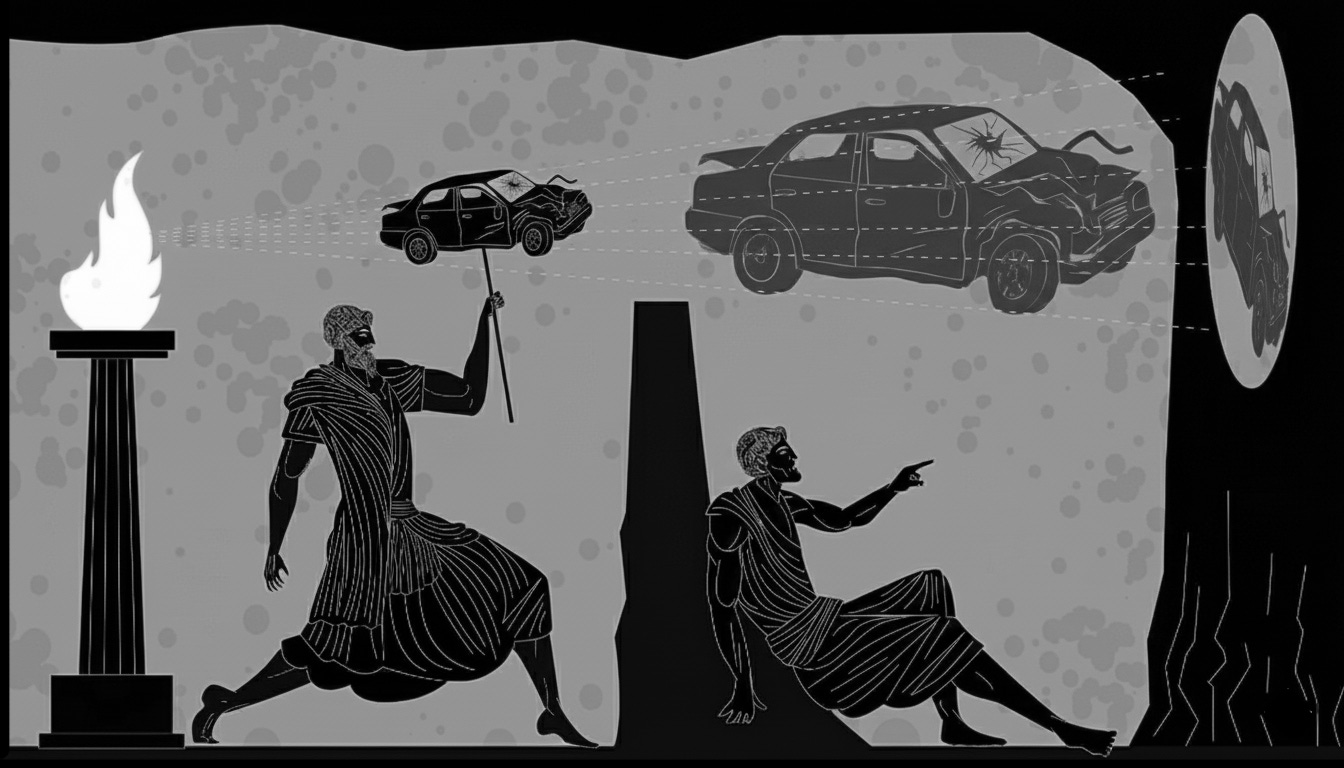
According to Plato, as described in the allegory of the prisoners in a cave found in Book VII of The Republic, most of us do not see reality itself but only images of it.
In the allegory, prisoners are chained in an underground cave, so that they can face only one wall. Behind them, higher up and farther back in the cave, burns a fire, and between the fire and the prisoners runs a raised path with a low wall, like a puppeteer’s screen. Along this path, people pass, carrying various objects and images that rise above the wall. The prisoners see only the shadows of these things cast on the cave wall before them, never the people or objects themselves. From these shadows alone, the prisoners form their beliefs about what is real and about how those things move.
But then the story twists. One prisoner escapes his chains and goes behind the wall, up into the sunlight, to see things as they are. It’s like seeing that a shadow that appears as a rabbit is actually a pair of human hands mimicking the animal’s form. At first, the prisoner is confused by this new reality and tries to reject it, but eventually, as he becomes accustomed to the sunlight, he accepts what he sees as real. Furthermore, he does not simply bask in the light; he bears a burden to return, to face hostility and disbelief, and to help others leave the shadows behind.
The shadows in the cave allegory raises essential epistemological questions: how do we know what we know, how do we move from opinion to knowledge, and when—if ever—do we actually make that move and encourage others to do so, too?
For the most part, viewing the world as shadows in Plato’s cave is a benign way to go through life. Answering epistemological questions about the nature of knowledge is probably best left to philosophers, who are educated to handle the task. Most of us can get by on our opinions and the opinions of others, until reality rears its head and demands our attention — as the events in Minneapolis, Minnesota, on January 7, 2026, have done.
Allow me to elaborate.
Streaming from reality
I watch a lot of streamed content on my very big TV set. It’s the centerpiece of my private home theater, a theater that 50 years ago would have been found only in the homes of the rich. Today, nearly everyone has one. Ours is a world in which there is more content, on bigger, cheaper screens, with more eyeballs glued to them than ever.
These days, I’ve been binge-watching all 7 seasons of the political drama, The West Wing. There are about 140 42-minute episodes in the series. That’s a lot of TV.
I know the show is a fantasy. The show’s President of the United States is a skilled politician who is intelligent, thoughtful, compassionate, and flawed. I like the show because it portrays politics and a political regime that could plausibly exist, confronting the rough-and-tumble, life-and-death challenges faced by governments in the modern world. The characters in The West Wing are men and women who want to do the good, right thing despite their limitations—limitations inherent in most human beings.
I prefer to watch the show rather than view the latest news broadcasts, because the news scares me. It’s as if the militaristic, good-guys/bad-guys world I read about in history books is unfolding before my very eyes. On the other hand, episodes of The West Wing comfort me. The show soothes my fears and anxieties about our modern, might-makes-right world.
In a way, I am like Plato’s prisoner in a cave. Only, in my case, the confinement is self-imposed. I am choosing to chain myself to the comfort of my electric recliner in my home theater and lie back while images of an imagined reality dance about before me on my TV set.
For a few hours a day, I live in a political world that suits me, albeit one based on a contorted version of reality. But now things have changed, and my world of illusion has given way to the reality of the events that transpired on a cold winter street in Minneapolis, Minnesota.
The risk of retreating from a revolting reality
These days, there are a lot of stories being told, in more ways, in more places. As AI technology evolves, it’s becoming harder to distinguish in those stories what is real from what is not. After all, if it looks like a duck, if it walks like a duck, and if it sounds like a duck, … well, you get the message. The problem isn’t so much that it’s getting harder to distinguish reality from images of reality; it’s that those images might be preferable to the reality they displace.
On January 7, 2026, in Minneapolis, Minnesota, a 37-year-old woman was shot three times by an agent of Immigration and Customs Enforcement (ICE). The woman was seated in the driver’s side front seat of a moving vehicle. Some stories say the agent fired in self‑defense to avoid being run over by her vehicle. Other stories say she was trying to move her vehicle away as instructed and was shot without reason.
These versions are but the shadows cast by mass media upon the wall of a cultural cave in which we are chained. However, when we take the chains off and move into the sunlight, to view the many nearly identical videos of the event, we see a law enforcement agent firing 3 shots into the front driver’s side window of a slowly moving vehicle. The visual evidence makes it hard to avoid the conclusion that the driver was the target of those shots.
My reaction to the video is one of horror. In fact, the horror is so intense that a very large part of me feels that if this is what reality is about, I want no part of it. I’d rather chain myself back into my electric recliner and watch episodes of The West Wing.
And therein lies the danger.
Today, we live in a world of infinite content and ubiquitous artificial intelligence technology that can contort reality into images that entertain us endlessly. These images have the potential to become more appealing than reality itself. The danger is that should reality become unbearable beyond the pale, we’ll revert to living in our chosen world of stories and shadowlike images, a place where everything is to our liking. It’s like a heroin addict who kicks the habit but, having to cope with the world as it really is, decides to go back to shooting up because life without drugs is more painful than life with them.
Fortunately, for as much as I want to retreat, I won’t get back to the recliner. I owe it to those I care about to live outside the cave, to live in the sunlight of reality, as painful as it might be.
We are past hyperbole. As events in Minneapolis reveal, the situation has become deadly. The imperative for me moving forward is to be keenly aware of those things and events that are real, and those that are merely shadows cast by profit-seeking media businesses, intent more on garnering viewer attention than on reporting the verifiable facts on which knowledge and, subsequently, effective political action can be based. Just as importantly, I need to not retreat into an all-too-easily accessible fantasy world but instead to stay in reality and take action.
This starts by publicly saying that while giving government agents a license to kill might be an acceptable entertainment in the fantasy of a James Bond movie, when it comes to living in the real world, government agents killing the governed just because they can is not OK. The rule of law counts in a civilized society, and accountable law enforcement matters for everyone, without exception, particularly when the use of deadly force is involved.
Given the life and death circumstances surrounding the events unfolding in Minneapolis, staying silent won’t work. Believing that these events are isolated incidents of political drama and that things will improve on their own is a comforting wish. Reality reveals otherwise. Now is the time to voice opposition and act accordingly in a non-violent manner, while such liberties are still possible. This is what I plan to do until the situation in the United States changes for the better. I hope that others do as well. Living in a world of comforting delusions, mistaking shadows cast on the cave’s wall for today’s reality will only lead to further tragedy.
Good article Bob. Your points about reality are quite cogent. For an even deeper inquiry I suggest Peter Kingsley's book titled Reality. And if you are not familiar with Charles Eisenstein, here's a clip https://www.youtube.com/watch?v=5C5SFzYaDW8
Powerful piece. Well constructed.
I sit in my recliner as well, and I remember the 80's. It's hard to forget the LAPD back then. For no reason, I was public enemy number one. All I needed was a baseball cap, a white t-shirt, and blue jeans.
The backpack with a calculus book didn't matter.
Social media put acts like this in all of our backyards. The tricky question is: is it or was it any different?